
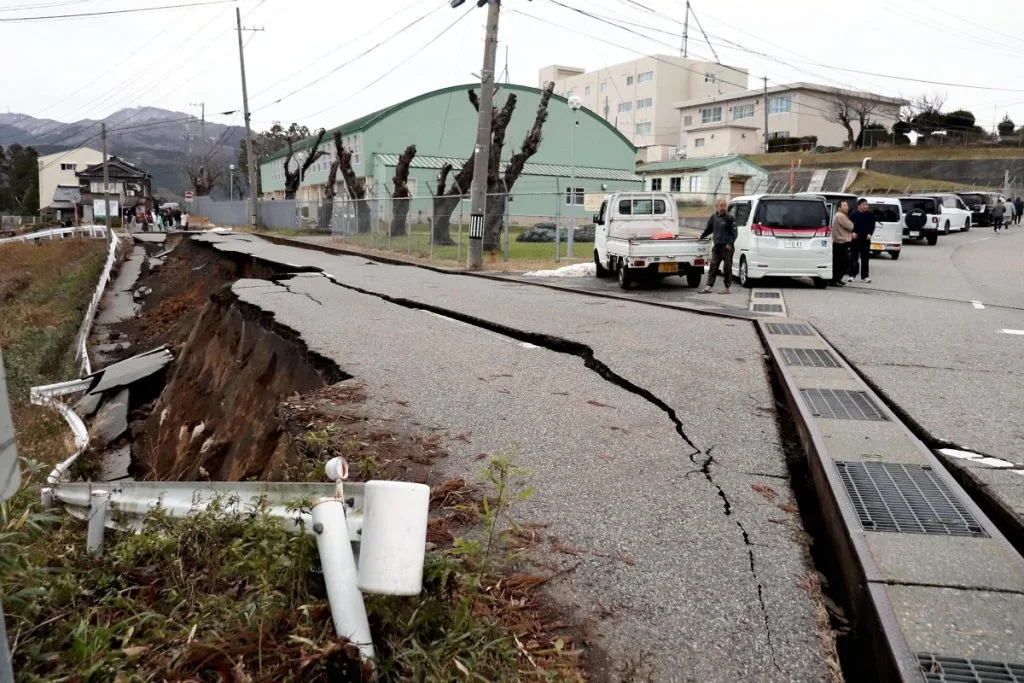
A powerful magnitude 7.5 earthquake shook northern Japan on Monday night, triggering widespread disruptions, shelter evacuations, and a series of strong aftershocks across the region.
Hundreds Take Shelter at Hachinohe Air Base:-
Defence Minister Shinjiro Koizumi confirmed that nearly 480 residents were moved to emergency shelters at Hachinohe Air Base, while 18 defence helicopters were deployed to survey structural damage and assist with emergency assessments.
Around 200 passengers were forced to spend the night at New Chitose Airport in Hokkaido, NHK reported. Part of the domestic terminal was closed on Tuesday after sections of the ceiling cracked and collapsed, according to airport authorities. Clean-up and safety inspections are underway.
Japan’s Nuclear Regulation Authority (NRA) reported that about 450 litres (118 gallons) of water spilled from a spent-fuel cooling system at the Rokkasho reprocessing plant in Aomori. Officials reassured that the water level remained within normal operational limits and posed no safety threat.
No irregularities were detected at other nuclear plants or fuel storage facilities across the region.
Aftershocks:-
The Japan Meteorological Agency (JMA) warned residents to remain alert as aftershocks continue to rattle the region. Authorities noted a slightly increased possibility of another powerful quake—potentially reaching magnitude 8—and a possible tsunami along the northeastern coast from Chiba to Hokkaido.
Residents in 182 municipalities have been urged to review emergency plans and stay prepared. The agency emphasized that this advisory is a precaution, not a prediction of a major disaster.
Epicenter Near Devastated 2011 Tsunami Zone:-
Monday’s earthquake struck just north of the area devastated by the catastrophic 2011 magnitude 9.0 earthquake and tsunami, which claimed nearly 20,000 lives and triggered the Fukushima Daiichi nuclear crisis.
“You must stay prepared, keeping in mind that a disaster of similar scale could occur again,” said JMA official Satoshi Harada.
Series of Strong Aftershocks Recorded
The U.S. Geological Survey (USGS) also detected significant aftershocks, including a magnitude 6.6 followed by a 5.1 tremor hours after the initial quake.
Tsunami Alert and Evacuations:-
Soon after the quake, authorities issued tsunami warnings for coastal communities in Aomori, Hokkaido and Iwate Prefecture.
Waves up to 70 cm (≈ 2 ft 4 in) were recorded along parts of the coast at some ports.
As a precaution, nearly 90,000 residents were ordered to evacuate or move to higher ground.
Officials from Nuclear Regulation Authority (NRA) reported about 450 litres (≈ 118 gallons) of water spilled from a spent-fuel cooling system at Rokkasho reprocessing plant in Aomori during the quake.
Importantly — NRA said water levels remained within normal operational range, and no safety hazard was identified. Other nuclear plants and fuel storage sites in the region were also declared stable.
Public Appeals:-
- The national government, under Sanae Takaichi, activated an emergency task force to coordinate rescue, relief and damage-assessment efforts.
- Authorities stressed that despite relatively limited structural damage so far, residents should take no chances — reinforce readiness, expect aftershocks, and treat all warnings seriously.
Aloso you read that:- Trump and Putin will meet again: Ukraine wants to end the war 2025 latest News